Electric Vehicles in the Southwest Region
Legislative Updates in Support of Electric Vehicles in the Southwest Region
Through the Inflation Reduction Act and the Bipartisan Infrastructure Law (1), the federal government has invested $47 billion to support widespread adoption of EVs, $1 billion of which is allocated to promote clean heavy-duty vehicles. This new legislation will support increased adoption of EVs in the future. According to EV Adoption's market projections, nearly 30% of vehicles in the United
States may be EVs in 2030. (2)
In response to federal investments in clean transportation infrastructure and technology, states across the country are responding by taking measurable steps toward meeting air quality and climate goals. (3) Within the Southwest region, California has traditionally been at the forefront of adopting EV-related legislation and policies. However, in recent years, other states across the Southwest region have proposed and passed legislation to increase sales of electric vehicles (EVs) and accommodate EV parking and infrastructure.
EV Sales Mandates
In 2023, Colorado and Nevada joined the growing number of states that have adopted Advanced Clean Cars and Advanced Clean Trucks rules, originally developed by California Air Resources Board (CARB), to expand statewide sales of zero-emissions vehicles (ZEVs). (4) The two regulations require auto manufacturers to meet a percentage sales standard for zero-emissions passenger cars and trucks in the state. The sales standard takes effect with vehicle model year 2027 and increases gradually through model years 2032 and 2035 for the clean cars and clean trucks rules, respectively. Under the new standard for passenger cars, 82% of new vehicles sold statewide will be ZEVs in 2032. (5)
EV Parking Spaces and Enforcement
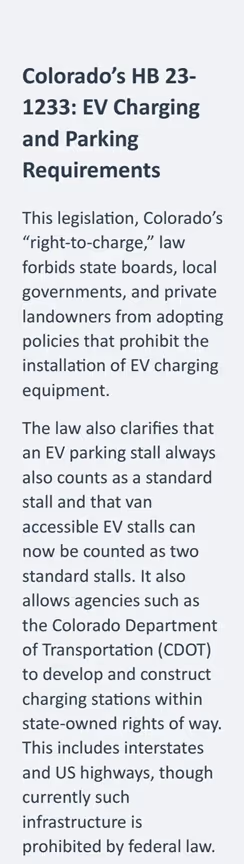
Along with EV sales standards, local and state governments in the Southwest region have recently adopted regulations to enforce compliance with the parking code for EV-designated parking spaces. Colorado has revised its statues to penalize (with certain exceptions) EVs not actively charging while in a designated parking stall with a citation of $182 (CRS 42-4-1701). Similarly, Nevada and Arizona have adopted regulations with penalties of $750 (NRS 484B.468) (6) and $350 (ARS 28-876), respectively, for non-EVs parking in EV stalls. (7) Colorado's recently passed HB 23-1233 (Electric Vehicle Charging and Parking Requirements), taking effect in early 2024, formalizes statewide rules for EV parking and charging stations and legal protections for EV charging stations in public and private facilities. (8)
EV Infrastructure Requirements
The State of Colorado has recently passed updates to the building code requiring EV-capable or EV-ready infrastructure in new developments. Both EV capable and EV ready refer to the electrical equipment that must be installed as part of new construction to enable easy installation of charging infrastructure. EV-capable infrastructure includes electrical panel capacity and a continuous raceway between the panel and future EV charging station, whereas EV-ready infrastructure also includes a 240 V charging outlet that is ready for equipment to plug in. (9) A key benefit of EV capable/ready infrastructure is that it reduces the cost of EV charging infrastructure by up to 75%, creating an incentive to expand EV charging stations to support the widespread adoption of EVs. (10)
Colorado's Statewide Building and Energy Code update for 2023 to 2026 requires that all new construction (both residential and non-residential), as well major additions and renovations, are EV ready. Under this code update, as of July 1, 2023, all Colorado municipalities were required to either adopt the state’s standards or update their building code to meet or exceed the new standards. Several communities in Colorado, including Aspen, the City of Boulder, Boulder County, the City and County of Denver, and Fort Collins, already had EV-ready requirements in their building codes prior to the statewide code update. (11)
Conclusion
States and local governments in the Southwest region must continue to take steps to ensure that EV charging infrastructure and parking policies keep up with the transition to electric vehicles, especially in light of state-level adoption of accelerated EV adoption and sales mandates.
- Christianson, Maggie. (October 30, 2023). Tracking electric vehicle investments in the Infrastructure investment and Jobs Act. EESI. https://www.eesi.org/articles/view/tracking-electric-vehicle-investments-in-the-infrastructure-investment-and-jobs-actand-inflation-reductionact#:~:text=The%20Inflation%20Reduction%20Act%20(IRA,the%20widespread%20adoption%20of%20EVs.
- EVadoption. (n. d.). EV Sales Forecasts
- EPA. (n. d.). Clean Heavy-Duty Vehicle Program. https://www.epa.gov/clean-heavy-duty-vehicles-program
- Environmental Defense Fund. (October 20, 2023). Colorado Becomes First State in Mountain West to Adopt Second-Generation Clean Car Standard. EDF. https://www.edf.org/media/colorado-becomes-first-state-mountain-west-adopt-second-generation-clean-car-standard
- Colorado Department of Public Health and Environment. (April 21, 2023). Home Colorado adopts new measures to increase availability of zero-emission trucks that offer lower operating and fuel costs. CDPH. https://cdphe.colorado.gov/press-release/colorado-adopts-new-measures-to-increase-availability-of-zero-emission-trucks-that
- U.S. Department of Energy. (May 29, 2019). EV Parking Space Regulation: Nevada. Alternative Fuels Data Center. https://afdc.energy.gov/laws/12277
- U.S. Department of Energy. (n.d.). EV Parking Space Regulation: Arizona. Alternative Fuels Data Center. https://afdc.energy.gov/laws/5596
- Colorado General Assembly. HB23-1233 EV Charging and Parking Requirements. Colorado General Assembly. https://leg.colorado.gov/bills/hb23-1233
- Oreizi, Darya. (November 23, 2020). What is the difference between EV capable, EV ready, and EV installed? Charged Future. https://www.chargedfuture.com/ev-capable-ev-ready-and-ev-installed/
- SWEEP. (n.d.). SWEEP guide to EV infrastructure building codes. SWEEP. https://www.swenergy.org/ev-infrastructure-building-codes
- Frommer, Matt. (October 23, 2018). Cracking the Code on EV-Ready Building Codes. SWEEP. https://www.swenergy.org/cracking-the-code-on-ev-ready-building-codes/
About the Authors
Renata Langis is a transportation planner at Walker Consultants who are passionate about multimodal transportation and sustainability. She can be reached at rlangis@walkerconsultants.com.

Vaishak Gopi is a Project Manager at Walker Consultants with experience in the structural engineering of parking garages. He can be reached at vgopi@walkerconsultants.com.

Related Blogs
Art Where you Park 2.0
TEDx

Burnout Isn't Always About Hating Your Job

Why Conferences and Trade Shows Are Important
A Note from SWPTA President, Peter Macdonald

Finding My Place in Parking: Reflections on Three Years in an Amazing Industry

The Innovation Wave: How Hospitality is Evolving in a Post-Rideshare World

Prioritization, Presence & Purpose: Finding Balance Without Burnout
.avif)
Industry Connections Worth Parking Long-Term
.avif)
Everyone’s Going Somewhere
.avif)
Here We Go Again
.avif)
Move It!
.avif)
Here We Go! Tips for Working on the Road
.avif)
Integrity
Be Part of the Solution
Join SWPTA today and help drive change in parking and transportation. Your involvement shapes the future of mobility. Let’s redefine transportation together.
Join the Movement
Shaping the Future of Parking
SWPTA extends sincere thanks to our sponsors, whose support makes our events, educational programs, and industry initiatives possible.

.avif)